Early Family Communication Starts Before Your Baby Can Talk
Early family communication begins long before a baby says a first word. Babies are already learning from tone, rhythm, facial expression, repetition, routines, touch, and the way caregivers respond to their cues.
That can feel like a lot of pressure, but it can also be reassuring. You do not need a complicated program to begin building communication. The ordinary moments you already repeat every day, such as diaper changes, feeding, getting dressed, bath time, stroller walks, and bedtime, can become simple opportunities for connection and language.
What early family communication means
Early family communication is the way a family builds understanding, connection, and trust before and during the years when a child is learning words. It includes what parents say, how they say it, what routines they repeat, and how they interpret a child’s behavior.
For babies, communication is not only speech. A baby may communicate through eye contact, body movement, facial expression, crying, reaching, turning away, relaxing, stiffening, or becoming more alert. A toddler or young child may communicate through play, repetition, refusal, big feelings, or behavior that seems inconvenient to adults.
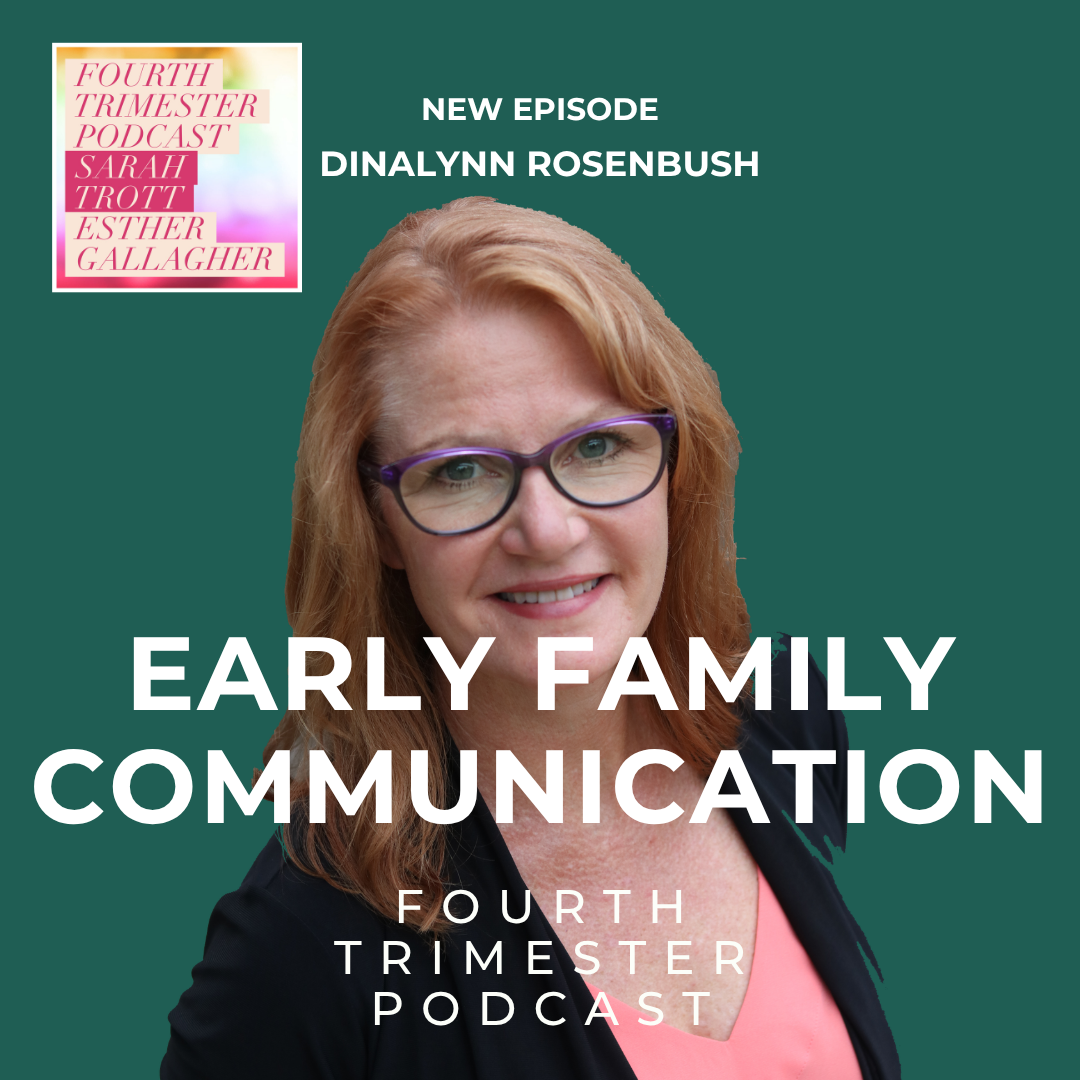
In the full Fourth Trimester Podcast episode, Sarah talks with Dinalynn Rosenbush, a speech-language pathologist, parenting coach, speaker, author, and host of The Language of Play, about how understanding the baby brain can help parents adjust expectations and support communication from the beginning. Listen here: Your Baby’s Brain Works Differently Than Yours.
Early family communication at a glance
- Start before words: babies learn through tone, repetition, eye contact, routines, and caregiver response.
- Use ordinary care moments: diaper changes, feeding, dressing, bath time, and bedtime are natural language moments.
- Repeat simple words: naming the same actions again and again helps babies connect language with experience.
- Watch behavior with curiosity: behavior can be a signal that a child needs help, connection, rest, predictability, or a different kind of support.
- Keep it playful: play and imagination can help children feel understood and make cooperation easier.
Why babies need repetition and routine
Adults can usually understand a new instruction from context. Babies and young children are still building that context. Repetition helps them predict what is happening and connect sounds, gestures, and actions over time.
For example, a parent might say the same short phrases during a diaper change: “Diaper off,” “wipe,” “clean diaper,” and “all done.” At first, the baby is not expected to respond with words. The value is in the repeated pairing of sound, tone, action, and caregiver attention.
Routines also help children feel more secure. When a child can predict what comes next, there may be less stress around transitions. That does not mean every routine has to be rigid. It means repeated patterns can help babies and young children make sense of daily life.
Simple ways to build early family communication
Talk through what is already happening
You do not need to narrate every second. Choose a few daily moments and talk through them simply. “We are putting on socks.” “You are drinking milk.” “I hear you crying.” “We are going outside.” These small phrases help connect language to real experience.
Use the same words in the same routines
Repeated words become familiar. If you say “up” before picking your baby up, “milk” before feeding, or “all done” at the end of a routine, those words begin to carry meaning because they are attached to predictable experiences.
Pause and watch
Communication is not only what the adult says. It is also what the adult notices. A pause gives you a chance to see whether your baby turns toward you, looks away, reaches, settles, fusses, or seems overwhelmed. Those responses can guide what you do next.
Use warm tone and facial expression
Babies and young children are highly responsive to emotional tone. A warm voice, relaxed face, and predictable rhythm can help communication feel safer. This is not about being cheerful all the time. It is about noticing that how something is said can matter as much as the words themselves.
Let play do some of the work
Play gives children a way to practice communication without pressure. Pretend play, silly voices, songs, turn-taking games, peekaboo, and simple imitation can all support connection. For older toddlers and young children, entering their world through play can make cooperation feel less like a battle.
Behavior is communication
One of the most useful reframes for parents is that behavior is communication. When a child is not doing what an adult expects, the behavior may be communicating confusion, fatigue, hunger, overstimulation, a need for connection, a missing skill, or a need for more predictable structure.
This does not mean every behavior is acceptable or that parents should ignore limits. It means the first question can shift from “Why won’t my child listen?” to “What might my child be trying to tell me?”
That shift can help parents respond with more curiosity and less shame. It can also help families build communication patterns that support cooperation over time.
How early family communication supports future learning
Early family communication is not a guarantee of any particular outcome. Children are individuals, and families have different needs, resources, and circumstances. Still, the daily patterns around language, tone, attention, and response can help create a foundation for trust, connection, and learning.
When babies hear repeated words in meaningful moments, when caregivers respond to cues, and when routines help children anticipate what comes next, communication becomes part of everyday life. Over time, those patterns can support a child’s growing ability to understand, participate, and express needs.
For more on how the baby brain differs from the adult brain, and how parents can adjust expectations from the beginning, listen to Sarah’s conversation with Dinalynn Rosenbush on Fourth Trimester Podcast: Your Baby’s Brain Works Differently Than Yours: How Early Communication Supports Future Success.
Related Fourth Trimester resources
For more support around early development and communication, you may also like Wire Your Baby for Success Through Optimal Newborn Brain Development, Encourage Infant Speech Development, Security & Confidence Through Communication and Play, and Why And How To Bond With Your Newborn.
FAQ about early family communication
What is early family communication?
Early family communication is the way parents and caregivers build connection, understanding, and language through tone, routines, repeated words, play, response, and attention from the earliest days of a child’s life.
Can I communicate with my baby before they can talk?
Yes. Babies communicate through cues such as crying, gaze, movement, body posture, facial expression, and changes in alertness. Parents can respond by using warm tone, simple words, repetition, eye contact, touch, and predictable routines.
Do I need special tools to support early communication?
No. Special tools are not required. Ordinary daily care moments can be powerful communication moments when parents use simple repeated language, pause to notice cues, and keep interaction warm and responsive.
Why does my child seem not to listen?
A young child may miss directions for many reasons, including development, distraction, fatigue, overstimulation, unclear expectations, or not yet having the skill an adult assumes they have. Looking at behavior as communication can help parents respond more effectively.
The takeaway
Early family communication does not have to be elaborate. It can begin with a repeated word, a pause, a warm tone, a predictable routine, or a playful moment of connection.
The goal is not to force adult understanding onto a baby or young child. The goal is to meet children where they are, build trust, and create a family rhythm where communication has been happening all along.
Listen to the full Fourth Trimester Podcast episode with Dinalynn Rosenbush here: Your Baby’s Brain Works Differently Than Yours.
The content provided in this article(s) is provided for informational purposes only and does not constitute medical or other professional advice. Neither Sarah Trott nor Fourth Trimester Media Group LLC are liable for claims arising from the use of or reliance on information contained in this article.